A 3 Step Approach
Teaching children can be tricky and is much different than teaching adults. Adults will more often have a longer attention span and can handle a bit more theory within the lesson. Adults have typically made the choice to be there and to learn, where as kids, on the other hand, are really only interested in having fun. So we either need to find a way to make the content fun or we hide the content inside the fun.
I have found some fairly consistent success with a certain approach that I’ve been utilizing for a while and I thought it might be worth sharing. This is definitely not the only approach, but hopefully it’s one you might be able to add to your repertoire. As I go through these steps, I will also share the example of a recent lesson where we worked on the roundhouse kick.
Part 1 - The Knowledge. Fun.
Part 2 - The Focus. Funner.
Part 3 - The Application. Funnest.
The Knowledge
This portion should come first and needs to be kept short. It can be used as a refresher for the older students, and/or as a brief introduction for the newer ones. You really only have their attention for maybe about 3-4 minutes here, max. Although this would be considered the “theory” portion of the lesson, it cannot just be talking, and needs to be balanced with doing. In fact, the doing should lead the lesson, not the talking. They also still need an opportunity within here to move and have some fun as well.
Roundhouse Example. We stayed set up as a full class with an instructor at the front. The Instructor immediately had them go into a bow stance (they did NOT start with talking) and had them do a few roundhouse reps. Then, while still in a bow stance, they started to refresh the class on the components of the roundhouse and took them through a few more reps in a “step-by-step” format, challenging their balance and having some laughs with it. They finished with the last few at full speed once again. This portion was kept short but active.
The Focus
This portion is a specific aspect that you want to work on and would also likely be the bulk of the lesson. So within the overall lesson, what will your main objective be for this particular class? Ideally, this is an activity where the student isn’t repeatedly TOLD what they should be working on, but rather is a fun game or challenge by which they will have no option BUT to work on said skill.
Roundhouse Example. We partnered the students up and had them find a dot along the ponywall. The first partner held the wall for stability while doing a roundhouse kick, up to and including the 3-point. While holding that 3-point, their partner then placed a bean bag on their ankle, from which point they were challenged to complete the kick (slowly) as many times as they could without dropping the bean bag. As far as the students were concerned, this was a “don’t drop the bean bag game”, which for them was a fun challenge. But in actual fact, they were working on their proper 3-point, their body alignment and hip strength.


The Application
This portion comes last and should be the most fun. We want to end the overall lesson on a really high note. This is also the students opportunity to apply what they were just working on and for the instructors to see how much of it potentially sunk in. I think of this section as “organized chaos” and should be fast paced with smiles and pink cheeks by the end. At this point in the lesson, I would be looking less to correct any of the students, and more just taking mental notes of what needs work the next time.
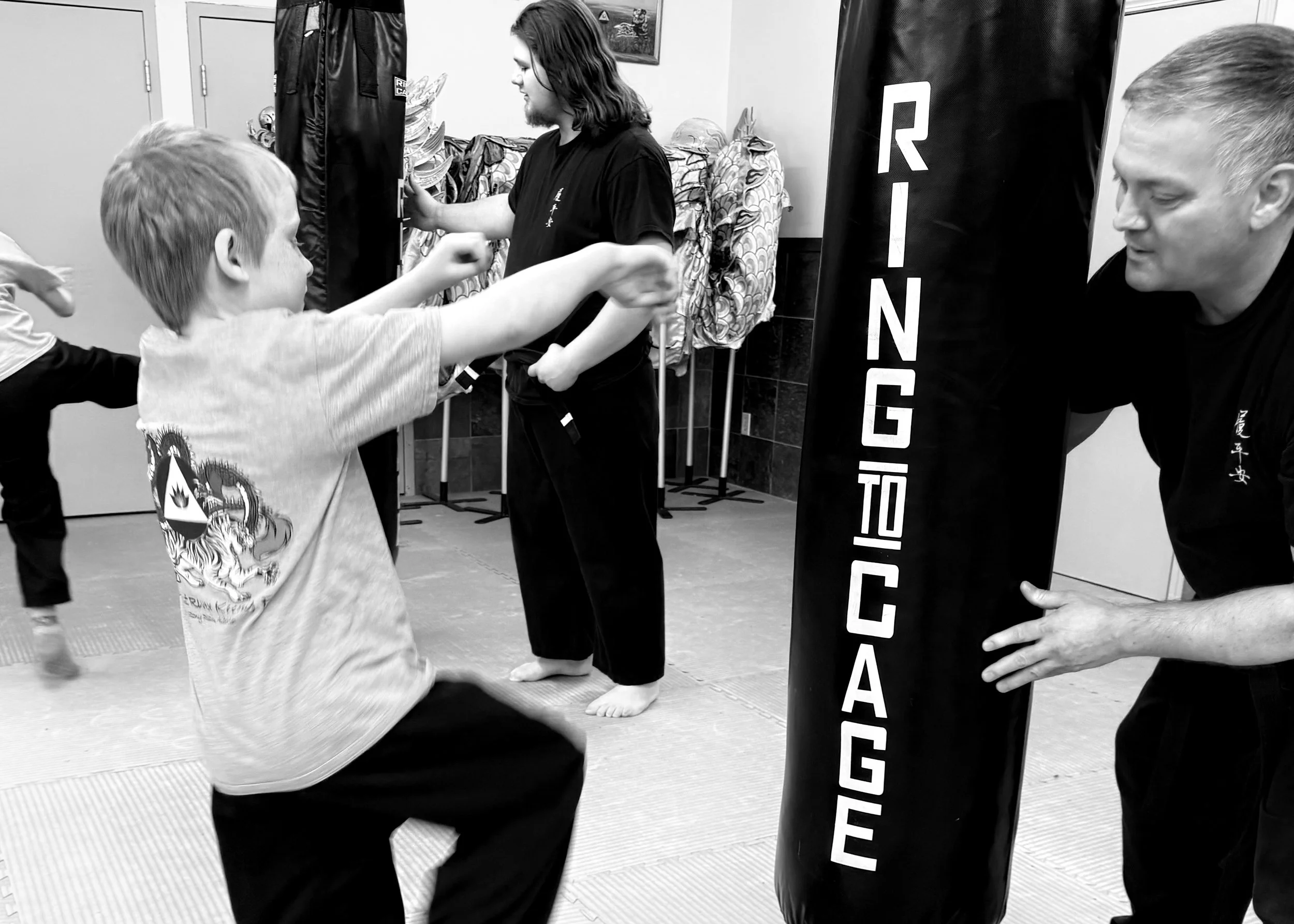
Roundhouse Example. We separated the students into groups lined up towards the heavy bags. They were challenged to run to the bag and then had to do 1 or more roundhouses at the direction of the instructor at that bag. The first round may have been a low roundhouse. The second, high then low. Third, high, low, high. And so on. The final round they got to do their best flying roundhouse.

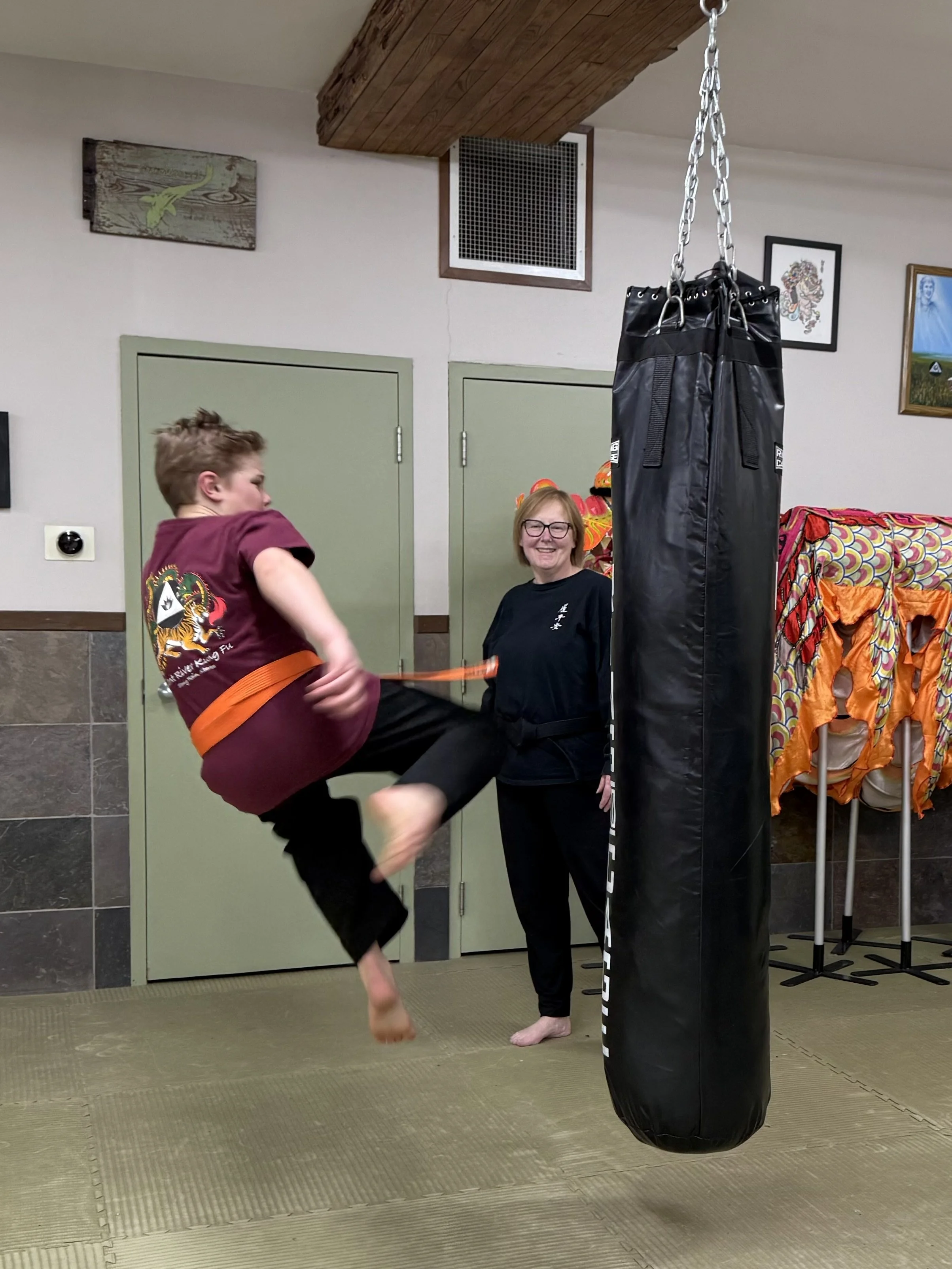
By the end of this particular class, I was really impressed by how their technique was looking in the Application portion. Everyone was pivoting and getting that proper body alignment that they had gotten used to along the wall, and many were implementing really good 3-points as well, especially when challenged with those different height kicks. And they were having a blast at the same time.
What truly made me realize that this approach had some benefits, was when Sihing N Csillag planned their next class on the side heel in the same format. It was essentially the same general setup, with different content, and the students didn’t even notice. At the same time, they were able to reiterate some of the similar skills between the roundhouse and the side heel (ie. the pivot and body positioning) and by the end of the second class we were seeing some really amazing progress. Sidenote: This is now making me take a good look at what lessons might work really well back to back.
When we discover a successful drill, our instinct tells us we need to replicate it exactly so that we get the same result. But what tends to happen is we will use it over and over to the point that it becomes old and boring, no longer having the same effect. Instead of copying the drill itself, I’m trying to figure out what made that drill successful and then replicate the approach. I think if we can figure out how to do that, the potential for successful drills, and successful classes, become endless.
Malinda Ferris
Kids' Classes Dismissal Process
Once the class has bowed out, and the students have received hand sanitizer, the dismissal process can begin.
Dismissals begin with the students at the back of the class and move towards the front. Exceptions can be made if there are siblings, who can be dismissed together at the discretion of the Instructor.
Children will collect their belongings from the changerooms and then will proceed to the entrance to collect their footwear.
Children will then proceed directly to the bench where they will sit and put on their shoes and outerwear.
Once they have their shoes and outwear on, they are to remain seated and watch for their parents/guardians out the window.
Once all children are in the penalty box area, the entrance door can be unlocked and the next class can begin to enter.
Once a child sees their parent/guardian, they are to put up their hand, indicating to the instructor that their parent is present at the exit.
The instructor will release children to their parent/guardian and ensure the parent/guardian has them in their custody.
Once all children have been released to their parents, the exit door should be locked.
General Rules And Guidelines
Children should only leave the mats at the direction of an instructor. Any child that attempts to leave without permission will be returned to their spot and will have to wait until an instructor releases them.
Should the main instructor dismissing children be tied up, other instructors or helpers should step in to keep the dismissal process flowing.
All children should be released through the penalty box door only.
No more than 3 children should be collecting their shoes at one time.
The instructor manning the exit should be dictating the order in which children are released, not the children.
Siblings should be released together.
No child should be released unless they are seated and waiting in a respectful manner.
Any children crowding the exit, or attempting to exit without the direction of the instructor, should be instructed to find a seat on the bench and should not be released until they do so, regardless of whether their parent is at the door.
Children should not be standing or walking around in the penalty box area during dismissal.
Children should only be released when it is safe to do so and a parent/guardian is present to take custody.
If a child arrived at class on their own and will be leaving in the same manner (ie. walking, bike or roller blades), the instructor should release them when they feel it is safest to do so (ie. parking lot has emptied).